
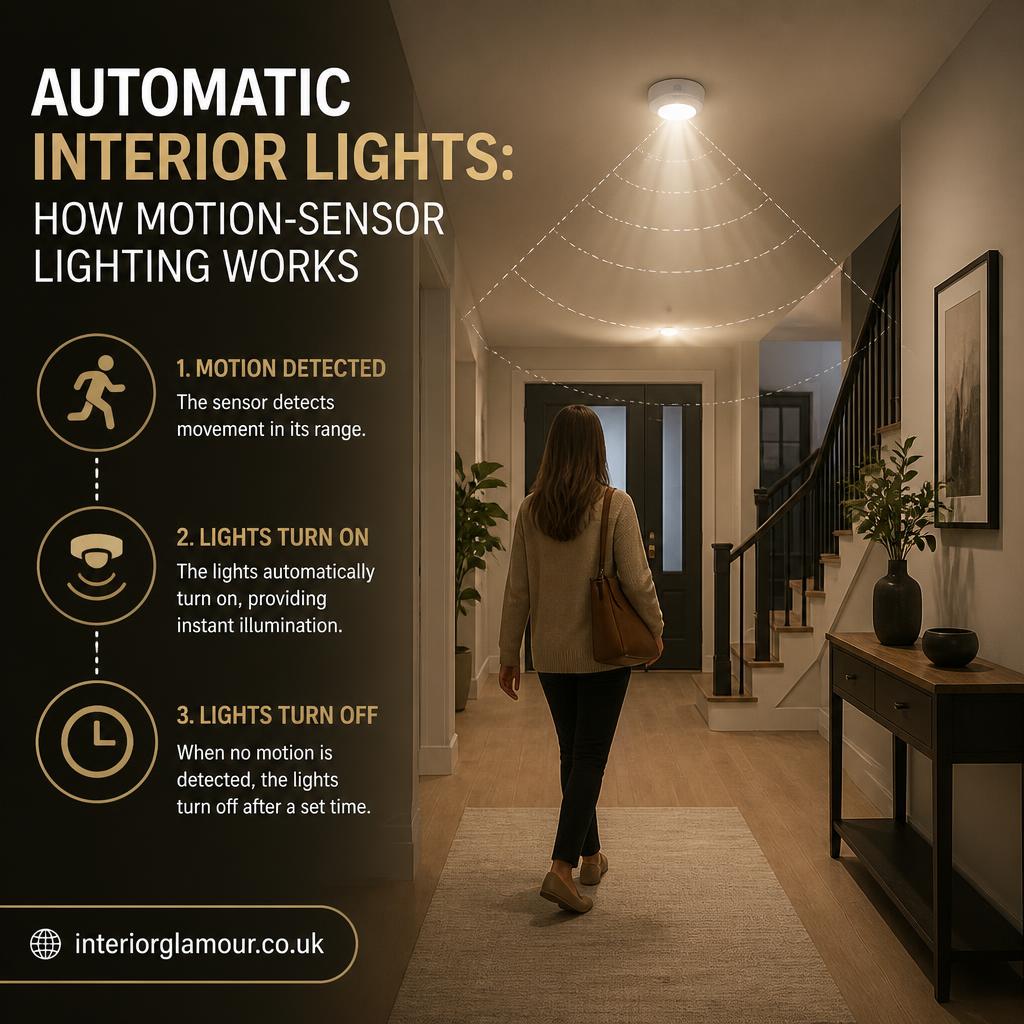
Automatic interior lights switch on by themselves, usually triggered by motion, a timer, or a light-level sensor. They’ve moved from being a security-focused feature to a genuinely useful addition in wardrobes, hallways, and stairs, where fumbling for a switch is a small but real daily annoyance.
How Automatic Lighting Works
- PIR motion sensors — detect body heat and movement within a set range, the most common trigger for automatic lights
- Light-level (dusk-to-dawn) sensors — switch on only when ambient light drops below a set threshold
- Timer-based systems — switch on and off at set times, regardless of movement or light level
- Door or contact sensors — common in wardrobes and cupboards, triggering when the door opens rather than by motion in the room
Best Uses for Automatic Interior Lights
Wardrobes and walk-in closets benefit hugely from door-triggered lighting, since it’s hands-free exactly when hands are full. Hallways and stairs suit PIR motion sensors well, particularly for night-time use, avoiding the need to find a switch in the dark. Under-cabinet kitchen lighting often combines both a manual switch and a motion trigger, for flexibility.
Battery-Powered vs Wired Systems
Battery-powered motion lights are the simplest to fit, sticking or screwing to almost any surface without any wiring. Wired systems integrate with the home’s existing circuits and tend to be more reliable long-term, but need an electrician for installation, particularly for anything beyond a simple plug-in unit.
Frequently Asked Questions
Do automatic lights use more electricity than manual switches?
Generally less, since motion-triggered lights only run while a room is in use, rather than being left on out of habit.
How sensitive are motion sensors to false triggers?
Most PIR sensors can be adjusted for range and sensitivity, reducing false triggers from pets or light passing through a window, though some fine-tuning is often needed after installation.
Can automatic lights be retrofitted to existing fittings?
In many cases yes, particularly with battery-powered units or smart bulbs that add motion detection without rewiring the existing fitting.