
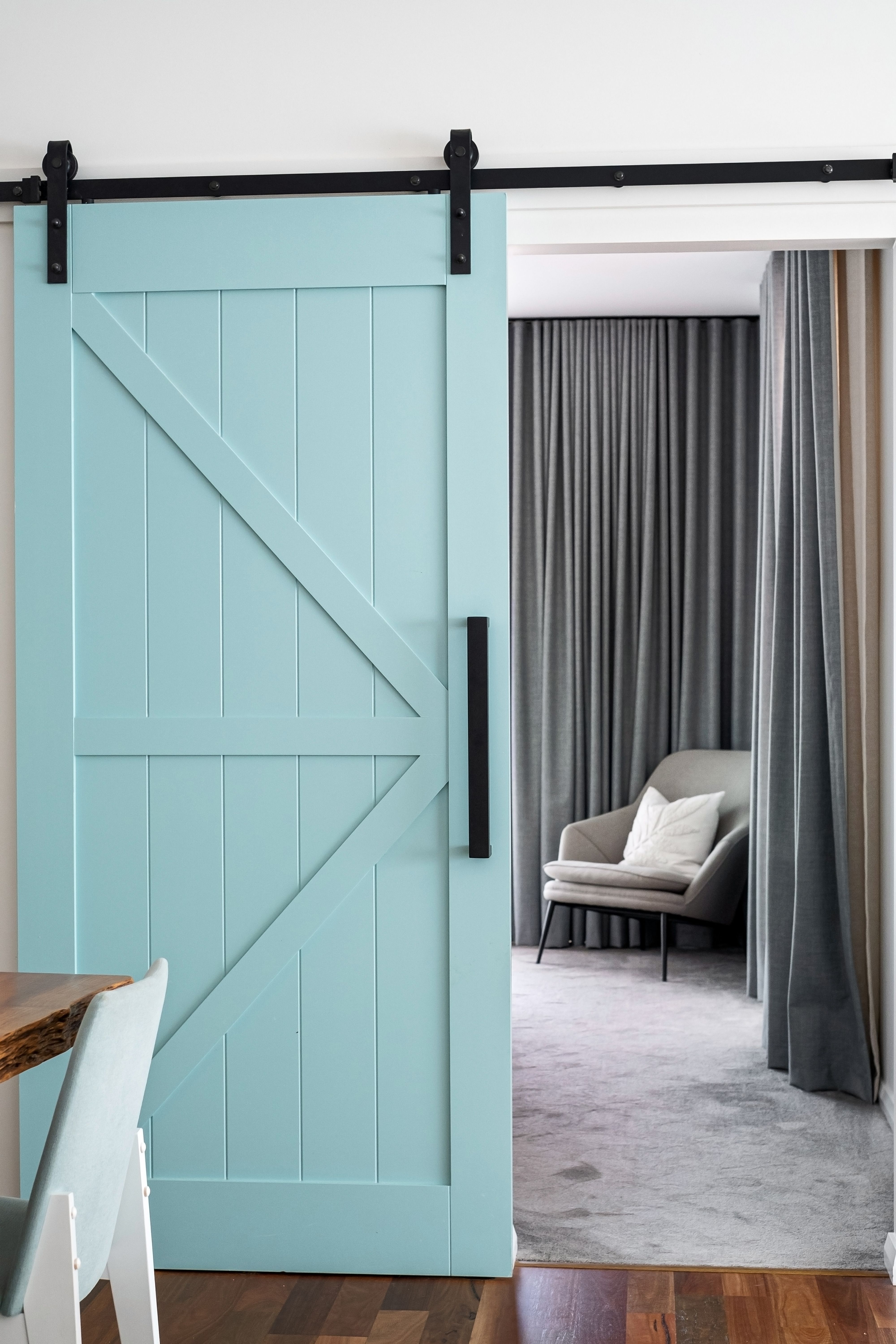
An interior door that slides runs sideways along a track, instead of swinging on hinges. That single difference removes the arc of floor space a normal door needs to open. It’s why sliding doors have become the go-to for small bedrooms, tight hallways, and en-suites, where a swinging door would clash with a bed, wardrobe, or sink.
The Core Trade-Off: Floor Space vs Wall Space
A hinged door needs roughly a quarter-circle of clear floor space to open. A sliding door needs none of that. But it does need somewhere for the panel to travel to:
- Surface-mounted — runs along the face of the wall on a visible track. No structural work needed.
- Pocket-mounted — disappears inside a stud wall cavity. Needs a pocket door frame kit, and usually a stud wall, not a solid masonry one.
Surface-mounted sliding doors are by far the more common retrofit choice in existing UK homes. A pocket door usually means opening up the wall.
Which Rooms Suit a Sliding Door?
- Bedrooms where a hinged door would hit the bed or a wardrobe
- En-suites and small bathrooms with limited floor space
- Home offices in box rooms, where every inch of floor space is needed for a desk
- Utility rooms and pantries, often paired with a glazed or panelled finish to match interior sliding doors used elsewhere
What to Check Before Choosing a Sliding Door
- Wall space to the side — a surface-mounted door needs clear wall roughly equal to the door’s width
- Weight rating of the track — solid timber panels need a heavier-duty track and rollers than a hollow-core door
- Sound and light gaps — sliding doors typically leave a small gap around the frame, so they’re not ideal for a room that needs full privacy or sound isolation, like a shared bathroom
Frequently Asked Questions
Do sliding interior doors lock?
Bathroom and bedroom sliding doors can be fitted with a privacy latch or a flush sliding door lock. But they generally offer less security than a hinged door with a proper mortice lock.
Are sliding doors noisier than hinged doors?
They can be. The panel isn’t sealed into a frame on all sides, the way a hinged door is. Soft-close track mechanisms, plus a felt or brush seal along the edge, reduce both noise and draughts.
Can an existing hinged door opening be converted to sliding?
Usually yes, for a surface-mounted slider, as long as there’s clear wall space alongside the opening. Converting to a pocket door is more involved, since it usually means altering the stud wall itself.